
|
|
CHAPTER 1
PREAMBLE
1.0 INTRODUCTION
Manufacturing is a transformation process by which raw material, labour, energy, and equipment are brought together to produce high quality goods. The goods produced naturally should have an economic value greater than that of the inputs and should be salable in the presence of competition. The transformation process generally involves a sequence of steps called production operations. Each production operation is a process of changing the inputs into outputs while adding value to the entity. Interspersed between these value-adding operations are the non-value adding operation, such as transportation, storing, and inspecting. It is necessary to minimize, if not eliminate, the non-value added operations.
The purpose of manufacturing is therefore to enrich the society through the production of functionally desirable, economically affordable, highly reliable, environmentally safe, top quality products. Of course another purpose of manufacturing is to provide gainful employment to drive the economy.
1.1 ADVANCES IN MANUFACTURING SYSTEMS
In recent years some major changes, such as variable customer demand, short period life cycle, and increasing worldwide competition, have taken place in the manufacturing industry. To meet these changes a company must be able to offer superior quality products at lower cost than competitors and still remain flexible if it wants ti survive in the business world. To achieve this goal, new manufacturing systems have emerged. All these trends lead to the recognization of the need of an integrated manufacturing. Integrated manufacturing means the integration at different manufacturing activities like processes, operations, product designs and their management which were treated separately in the traditional methods, into one system for complete control of the manufacturing facility and there by achieving the goal to find the optimum method of producing high quality, low costs products efficiently. All these have led to the innovations of a number of manufacturing strategies [18]. The major advances in integrating all aspects of manufacturing have led to computer integrated manufacturing which includes flexible manufacturing systems, JIT systems, agile manufacturing system, and the cellular manufacturing systems.
1.2 FLEXIBLE MANUFACTURING SYSTEM [40]
A flexible Manufacturing System (FMS) integrates all major elements of manufacturing that have been described so far. It consists of a number of manufacturing cells. It consists of a number of manufacturing cells each having an individual robot and serving several CNC machines and an automated material handling system interfaced with the computer. This system is highly automated and is capable of optimizing each step of the total manufacturing operation. It can handle a variety of part configurations and produce them in any order. The quick response to product and market demand variation is a major attribute of FMS.
1.3 JUST IN TIME CONCEPTS
The Just-In-Time production concept was developed in Japan to eliminate waste of materials, machines, capital, and inventory throughout the manufacturing systems. It has the goals like purchase supplies just in time to be used, produce parts just in time to be made into subassemblies, produce subassemblies just in time to be assembled into finished products and produce and delivery finished products just in time to be sold. It is a pull system meaning that parts are produced to order and production is matched with demand for final assembly of products. The advantages of JIT are low inventory carrying costs, reduced inspection and rework of parts etc[18].
1.4 AGILE MANUFACTURING SYSTEM[18]
It is the science of business system that integrates the management, technology and workforce and makes the system flexible enough for a manufacturer to switch over from production of one component to other component in a cost effective manner. It includes the entire business starting from planning, finance, processes, design, layout, materials and inventory, marketing, sales, series, technical supports etc. It has become an absolute necessity in view of the demands on customer-oriented products to produce components of international standards in terms of quality and costs. Integration of information technology is the core of Agile Manufacturing System
1.5 BATCH MANUFACTURING - GT CONCEPTS
Batch manufacturing is a dominant activity in the world, generating much industrial output. The major characteristics of batch manufacturing are a level of product variety and small manufacturing lot sizes. The product variations present design engineers with the problem of a design stage that significantly affects manufacturing cost, quality and delivery times. The impacts of these product variations in manufacturing are high investment in equipment, high tooling costs, complex scheduling and loading, lengthy set-up times and costs, excessive scrap and high quality control costs. However, to compete in a global market, it is essential to improve the productivity in small batch manufacturing industries [3]. For this purpose, some innovative methods are needed to reduce product costs, reduce lead time and enhance product quality to help increase market share and profitability. Group technology concepts allows for small batch production to gain economic advantages similar to mass production while retaining the flexibility of job shops methods.
1.6 SCOPE OF THE PROJECT
This project study relates to algorithms to forms cells and the specific scope can be identified as to study the concepts of Cellular manufacturing,have an overview of the various traditional cell formation algorithms, study and analyze various innovations in cell formation algorithms, especially the recent applications in cellular manufacturing systems develop a few algorithms and carryout detailed comparative studies, using simulation
1.7 OUTLINE OF THE REPORT
This report is divided into 6 chapters;
This chapter discusses about manufacturing systems, its advances and types of manufacturing system in CIM environment
Chapter2 gives a brief review of perspectives of Group technology- historical development of CMS, issues related to CMS, its advantages and disadvantages along with its applications
Chapter 3 discusses about different cell formation techniques with their advantages and disadvantages.
Chapter 4 focuses on the traditional algorithms developed so far.
Chapter 5 discusses about the modern techniques of cell formations. It gives a brief idea of how the concept of fuzzy logic, neural network, Genetic algorithm, Simulated annealing are applied to CMS
Chapter 6 summarizes the whole report and present the problem on hand and the plan for future work
CHAPTER 2
GROUP TECHNOLOGY- A PERSPECTIVE
2.0 INTRODUCTION
Group technology (GT) is one of the most important technological improvements applied to the batch processing industries. Group Technology is the management philosophy that believes similar activities should be grouped and performed with similar methods. The activities include product design, process planning, fabrication, assembly and production control. Apart from this, Group Technology can be applied to administrative functions as well. Burbidge (1971, 1975) [8]and Mitrofanov (1966) originally proposed this approach. This philosophy with his broad applicability potentially is affecting all areas of a manufacturing organization (De Vries et al, 1976 Hyes 1984). [42] One such application of Group Technology is Cellular Manufacturing.
Cellular manufacturing is a hybrid system linking the advantages of both the job shop and the product layout of the continuos flow line. It focuses on the creation of manufacturing cells within which a number of part families are manufactured. A cell consists of a set of functionally dissimilar machines, which are placed in close proximity to one another and dedicated to the manufacture of a set of part families. A part family is a set of parts that are similar in terms of processing requirements. A fundamental issue of cellular manufacturing is the determination of part families and machine cells. This issue is known as cell formation problem
2.1 HISTORICAL DEVELOPMENT
Research into the application of group technology for manufacturing first began during the late 1950’s. Around this time, researchers began to recognize that some parts share common manufacturing approaches. They soon concluded that parts with common manufacturing attributes could be grouped together and processed in a manner similar to mass production. Using this theory, they would create groups of similar parts and then dedicate groups of machines and tools specific to the production of these parts to reduce setup times. The first researcher to gain renown for this theory was S.P. Mitrofanov of the U.S.S.R. Though Mitrofanov began his work in the early 1950’s, but the genesis of group technology can be traced backed to the work carried out in the erstwhile U.S.S.R (Lpkplovsky, 1938) and Germany (Brady 1933), to extend formal standardization as reported by Gallagher et al. [17].
In subsequent years, several classifications and coding systems for forming part family were proposed. Companies first started to reorganize manufacturing facilities along GT lines in the early 1960’s and the concept of GT was strongly accepted round the globe. The approach of Production flow analysis (PFA) introduced by Burbidge considers wider aspects of production such as factory flow system, plant layout etc. Even though GT concepts can be applied for a variety of business problems in this area, the largest application has been in the manufacturing area and since then, always used in conjunction with Cellular manufacturing systems. During the 1970’s cellular manufacturing systems gained much more importance and later on this concept of manufacturing cells was extended to flexible manufacturing cells to cope with dynamic market situations. Today most of the developed countries have set Group technology in its proper context as a mainstream contributor to improved productivity and have applied this concept in all directions of manufacturing like JIT, CIM systems.
2.2 ISSUES IN CELLULAR MANUFACTURING
Issues involved in designing of cellular manufacturing systems are identification of part families, the identification of cell equipment and allocation of families to equipment (or vice versa). Besides identifying similar parts and machines, several objectives and constraints are of importance when cell systems are created.[33]
Cell Independence: Completely independent cells (i, e part operation sequences do not span multiple cells) is considered the primary objective in the cell formation.
Cell Flexibility: For the cell formation problem, flexibility related to the ability to process parts on alternate machines inside a cell (internal routing flexibility), the ability to release parts to alternate cells (external routing flexibility) and the ability of the cells to accommodate new parts (process flexibility) are the most important issues to be taken in design of cellular manufacturing.
Cell system layout: When cell independence is not complete, parts will move between cells, and possibly also between cells and the remaining job shop. Therefore spatial arrangement of cells affects move distances and material flow patterns.
Cell layout: The within-cell layout of the machines is another factor affecting move distances, material floe patterns and ease of control
Cell Size: The size of the cell, which is the measure of machines or processes, or the number of machine/process types allocated to a cell, is a variable that needs to be controlled. For example, the size of the cell should not be so large, it hampers the sociological environment in the cell or the visible control of the cell.
Additional Investment: A major assumption behind the routing based cell formation techniques are that existing machine clusters are broken up and reclustered. This corresponds to rearrangement of equipment on the factory floor. Ideally such a rearrangement should be done without the need to acquire additional equipment.
2.3 ADVANTAGES OF CELLULAR MANUFACTURING SYSTEMS
The traditional type of organization for manufacturing is process organization, in which organizational units each specializes in a particular process. This is gradually being replaced by GT, in which the organizational units (groups) complete all the parts they make at their particular processing stage, and are equipped with all the machines and other facilities they need to do so. GT addresses a lot of benefits like [9];
Setting time reduction
Making parts in small batches orders to a short cycle to reduce stocks and improve flexibility.
Increases machine efficiency and capacity
A reduction in the tooling arrangement.
A reduction in setting costs and operation costs.
Cell layout
Most of benefits of Cellular manufacturing systems are addressed by cell layout.
Reduced throughput time due to reduced lead time.
Improved ability to follow market changes
Reduced stocks and WIP
Centralization of responsibilities
Reduced handling and setting costs
Simplification of paper work-more accurate costing
Reduced indirect labour-better cost analysis
Improved human relation and better communication
Reduced investment per unit output.
Improved Quality of work
Flow control
Simplified material flow is achieved within the cells resulting in the following advantages.
Reduced material obsolescence
Reduced material costs
Reduced indirect labour
Elimination of inter-departmental stores.
Design standardization
Cellular manufacturing is applied in design by having design engineers code and classifies their design based on a predetermined selection of characteristics. When a new design is to be developed the engineer can search the database developed for previous design, review the alternative choices presented to him and possibly locate an existing system that will satisfy them.
Process planning
Group Technology and Process planning form a natural relationship . Here products are formed into families based on their characteristics. Process plan orders routing are then generated for the families and group of families. The benefits of their partnership are reduction in the number of process plans, increased speed in developing the process plans etc.
Purchasing
Families of items are formed and purchasing of each family of item is assigned to one buyer. So these families will yield larger quantities and thus creating large quantity buy discount. The buyers who are assigned to different families become expert among purchasing of these families.
Emphasis on people involvement.
A small group of people is assigned to one cell with a supervisor for that cell who is completely responsible for the production of that cell. There is constructive involvement of all the people in the cell as they know the significance of each and every operation to be performed in that cell. This is because each cell acts as an autonomous body and the product is manufactured in that cell only. They feel a sense of ownership and become conscious for the quality of the product and the target of productions.
|
Rank |
Reason |
Average importance |
|
1 |
To reduce throughput time |
4.51 |
|
2 |
To reduce WIP inventory |
4.33 |
|
3 |
To improve part/product quality |
4.22 |
|
4 |
To reduce response time to customer orders |
4.22 |
|
5 |
To reduce move distances/move times |
4.14 |
|
6 |
To increase manufacturing flexibility |
3.81 |
|
7 |
To reduce unit cost |
3.8 |
|
8 |
To simplify production planning and control |
3.62 |
|
9 |
To facilitate employee involvement |
3.57 |
|
10 |
To reduce setup times |
3.43 |
|
11 |
To reduce finished goods inventory |
3.41 |
Table 2.1 Reasons for establishing manufacturing cells [42]
2.4 LIMITATIONS OF GT
The major limitations of the GT are that it depends on the assumptions made and is too idealistic. GT has limitations on two issues,
Cell Design
The formation of proper cells cannot be separated from the success of a GT system. There are certain critical problems associated with such design.
Difficult load balancing
Possible low utilization of non-key machines
Difficulty in batch size selection
Bottleneck machines are allotted to the remainder shop-loss of CM advantages
Hardly any factory product range can be divided into clear cut component families.[34]
Invalid assumptions
Many GT assumptions are impractical and hence invalidate many of the advantages addressed.
Job satisfaction may fail due to reduced variety of job processed in cells.
Stocks and WIP are high, as machines require their own pool rather than
sharing the common pool as in functional layout.
Production control coordinating the various cells is difficult.
2.5 IMPLEMENTATION OF CELLULAR MANUFACTURING SYSTEM
Implementing cellular manufacturing is not as easy as it looks. It involves a series of vital steps so that parts or products are actually produced by the system. The scale of the cellular manufacturing implementation varies from manufacture to manufacture depending on the scale of the business and on the objectives of the firm.
The following 5 steps are necessary for manufactures to successfully implement cellular manufacturing[42].
Step 1: A manufacture has to organize parts that have similar characteristics into part families. Each family should produce higher volumes because the higher the production volume, the more efficient the production process within a cell will be.
Step 2:After parts are assigned to certain cells, a firm has to know what types of machine are required for each cell to produce parts or products. Some machines may need to be purchased in the case of that parts in a one cell and parts in another cell both require the same machine.
Step 3: In this step, workers must be trained and educated. This is the most important part of cellular manufacturing implementation. In cells, workers are required to operate multiple machines and take more responsibilities. Therefore, continuous training and education programs are necessary for improving manufacturing productivity. Moreover, well-trained and well-educated supervisors have to be given more responsibility.
Step 4: Rules, management policies, management techniques, or compensation system may have to be changed before cellular manufacturing actually starts working. These changes are critical for cellular manufacturing to be fully beneficial.
Step 5: The final step is relocating the machine to begin production in the cells. Although the amount of time and cost it takes depends on the scale of rearrangement it requires, the rearrangement should avoid conflicts with any other production lines.
|
Sl. No. |
Factors |
Importance |
|
1 |
Cell design and operation |
|
|
Equipment placement /cell layout |
8 |
|
|
Choice of equipment and MHS |
7 |
|
|
Capacity balancing and production flow |
6 |
|
|
Setup times/ tooling problems |
5 |
|
|
Production planning/control system |
2 |
|
|
Product design consideration |
1 |
|
|
Purchased parts availability |
1 |
|
|
30 |
||
|
2 |
Implementation factors |
|
|
Planning for conversion |
8 |
|
|
Education and training |
8 |
|
|
Implementation time |
3 |
|
|
Measurement and reward system |
2 |
|
|
Top management support |
1 |
|
|
22 |
||
|
3 |
Human issue |
|
|
Employee involvement |
12 |
|
|
Operator/cell leader selection |
3 |
|
|
Job rotation |
1 |
|
|
|
Job rotation |
16 |
Figure 2.2 Factors considered of great importance to cell operation and implementation [42 ]
2.6 APPLICATIONS OF GT
GT is slowly gaining hold in the industries all over the world. Knight [8] observes that GT principles have been applied in many fields including machining, welded fabrications, foundry work, presswork, forging, plastic injection moulding etc. The reason for GT’s popularity is because of various success stories about its implementation by the industries. Applications include many types of industries like metal processing industries, equipment industries, electrical and electronic products oriented companies and automobile part manufactures.
But the question of applicability is intimately related to issues such as system design, justification, and implementation. Thus CM system that has been well designed, economically justified and successfully implemented has only proven its applicability.
Thus applicability of GT concept for a particular company is not merely a technical issue, based on factors such as types of parts produced, demand volumes, etc, but also hinges on the organization’s readiness for CM and tha actions taken by the firm during system implementation. (Ettlie 1984, Gerwin 1981)[42]
In the first case of course Japan makes extensive use of CM in order to achieve Just In Time (JIT) Manufacturing (Monden 1983, Schonberger 1982). In the last few decades the US and European companies have also learnt and implemented successfully the Japanese strategy.
This grouping philosophy has been widely used in Flexible Manufacturing System (FMS) (Kumar et al 1986,Kusiak 1985) and in JIT production. Schonberger 1982, Stecke 1983 [40] has identified five sub problems to be solved before production in the FMS begins which are - part type selection problem, machine grouping problem, part mix ratio problem, resource allocation problem and machine loading problem.
2.7 GROUP TECHNOLOGY SUCCESS- A CASE STUDY[43]
Ingersoll-Rand Company’s Engineered Pump Division manufactures centrifugal and hydraulic pumps for the mining, military, flood control, and municipal water supply industries. In 1984, a management evaluation concluded that the operation was antiquated and too large to maintain its competitive position.
2.7.1 PROBLEM
Their machining, assembly, and test departments were scattered throughout four buildings up to half a mile apart. Also, machines were grouped together by type, resulting in inefficient material flow. Existing equipment included a low quantity of NC/CNC machines. Specifically, the evaluation indicated that lead times were high due to
|
Category |
Subcategory |
Factors |
|
Product |
Structural/internal |
Part/product size |
|
|
Sturdiness/fragility of parts |
|
|
|
Commonality of raw materials |
|
|
|
Phyisical similarity of parts |
|
|
|
Ease of part movement |
|
|
|
External |
Criticality of parts |
|
|
Stability of design |
|
|
|
Stability of demand |
|
|
|
|
Length of product life cycle |
|
|
|
|
|
Resources |
Machines |
Availability of duplicate machinery |
|
|
Capacity |
|
|
|
Limited space |
|
|
|
Commonality of capital intensive equipment |
|
|
|
Machine maintenance requirements |
|
|
|
Machine flexibility |
|
|
|
Capital |
Cost of cross-training of workers |
|
|
Cost of capital |
|
|
|
Cost of new equipment |
|
|
|
Cost of equipment reallocation |
|
|
|
Workers/labour |
Flexibility of workforce |
|
|
Union/non-union workers |
|
|
|
Safety constraints on machine location |
|
|
|
Information |
Experience with GT |
|
|
Availability of routing information |
|
|
|
|
Availability of capacity information |
|
|
|
|
|
Operational |
Process |
Setup time/run time |
|
|
Move time |
|
|
|
Numbers of operations per part |
|
|
|
Routing flexibility |
|
|
|
Variability of processing times |
|
|
|
Batch sizes |
|
|
|
Manufacturing technology |
Age of equipment |
|
|
Degree of automation |
|
|
|
Stability of technology |
|
|
|
|
Continuity of manufacturing process |
Table 2.3 Factors affecting cell design [5]
manufacturing methods, planning, and part flow, that inventory levels were high, and systems were outdated. In short, the facility was a low-tech shop trying to produce a highly engineered product with consistent quality and tight tolerances.
7.2.2 STEPS TAKEN
This evaluation led to a corporate commitment to improve the operations by creating a "factory of the future." Initially, a thorough analysis of the existing business was conducted, including future markets, old and new products, and sales levels. Next came an in-depth analysis of parts and their manufacturing strategies, and existing equipment, and the development of part families to support planning for cellular manufacturing. A team-oriented structure was used through the planning and implementation process. Employee groups, including direct labor worker, supervisors, and engineering support, worked to define the needs, secure capital equipment, implement the physical and philosophical changes.
The result of these preliminary-planning steps was a division wide objective-to consolidate and modernize the Phillipsburg operation, to reduce: product cost, manufacturing lead times, space requirements and overhead costs, and inventory levels (while improving inventory turns). While the primary emphasis was on implementation of cell technology and conversion to Just in Time manufacturing, several other subprojects were also completed, facility upgrades (new floors, shipping and receiving areas, and manufacturing offices), acquisition and installation of new manufacturing equipment, implementation of DNC (direct numerical control) technology, relocation and modernization of: support functions such as hydro test, shipping, receiving, and inspection), storerooms, and test stands/loops.
The overall program was planned as a five-year effort. An extension portion of this time (four years) was to be devoted to planning and detail engineering. Final implementation was to take place during the fifth year. (Part of the "planning" phase was actual implementation of a pilot cell to debug the approach, identify critical roadblocks-either people or technology-to ultimate success, and give everyone firm successes before undertaking the full-scale implementation.)
The team members going through this process encountered a number of psychological barriers, including a "resistance to change" attitude within the division. Some of the diverse disciplines now interacting together had years of isolation to overcome with regard to participating in any division improvement activities. In some cases, no one had ever asked these people what they thought before.
A part family analysis indicated that 12 manufacturing cells would be required in the manufacturing operation. Parts were first grouped by geometry (complexity), size, and annual production quantity. The resulting cells were first analyzed on paper, and then detailed in a scaled 3-D model. This model gave the team the ability to rearrange the individual machines within the cell and all the cells to optimize both the internal cell flow and overall factory flow. The model was also a display tool for the various vendors and contractors, and a teaching tool for internal personnel. Since it was decided that production would not be slowed during the rearrangement, a detailed proximity and sequence of machine tool/area moves was developed. The 12 cells that were developed and implemented were: four ring cells, grind cells, shaft cells, impeller cell, one small VTL (vertical turret lathe) cell, one large VTL cell, prismatic cell, material prep cell, and a general machining cell. In excess of $10 million was invested to purchase CNC tools, build shipping and receiving facilities and new test loops, and rebuild selected equipment. Additional expenditures were for small equipment and tools, and DNC implementation.
2.7.3 RESULTS
Nearly five years after the project began, the results of the cells are evident: reduced lead times, part manufacturing cycle times, and work-in-process and finished inventory levels. The four ring cells, the first to be installed, resulted in specific productivity improvements:
The introduction of new equipment with "live" tooling and right-angle milling and drilling capabilities eliminated secondary operations setups.
Utilization of group technology techniques minimized the number of setups, while standard current tool packages reduced setup costs.
The use of check cuts reduced the constant adjustment of tool offsets, in turn reducing cycle time and improving quality levels.
The improved equipment reduced cycle times because of the increased speeds and feeds.
Overall results were:
A 40% reduction in setup time;
A 30% reduction in cycle time;
A 20% reduction in the number of operations;
A 50% reduction in work-in-process and finished inventory.
The facility space reduction project, also part of the factory-of-the-future effort, resulted in a revised facility with wider buildings, more height under crane hooks, increased crane capacity, and improved access. The new layout of the five shops (Shops 7 through 11) enabled work to move from shop to shop without exposure to the elements. Initially, the production process required 381,000 square feet; after consolidation, only 250,000 square feet were required—a 34% reduction. The picture below shows the consolidated shop layout, where overall part flow is less than 10% of the original. Machine tools are grouped according to the family of parts being manufactured in each cell.
According to managers at Ingersoll-Rand Company’s Engineered Pump Division, this effort provided many lessons, among them:
The need for a completely defined commitment from management—constant changes in directions and plans are not recommended;
The need for a more diverse project team composed of departments affected most by the decisions.
Another important conclusion was that consultants should be part of the process to introduce new concepts, establish goals, and prepare and execute plans. At a certain point however, they should be phased out so the internal employee team can finish developing and implementing the plans, fostering ownership, reliance on textbook solutions should be avoided. A blend of textbook concepts and real-life experience will produce a plan that is realistic, achievable, and livable.
The implementation of this factory of the future was a major undertaking for the division compared to the size and scope of previous projects. New manufacturing strategies were introduced—cells, JIT receipt of materials, production per customer order (not made for stock), DNC—and involved a division wide team effort with full corporate support. The successes at the Engineered Pump Division prompted other Ingersoll-Rand sites to plan to implement similar strategies.
2.8 CONCLUSION
Cellular manufacturing is gaining increasingly popularity as a way to quickly improve productivity and competitiveness. As a result, it becomes necessary to address the issues related to CMS. An attempt has been made to describe the issues related to CMS, advantages and disadvantages of GT and the factors to be considered for implementing GT. Apart from this, development of GT and it applications are also been discussed in this chapter. Finally a case study of Ingersoll-Rand Company has been presented. In the next chapter, we will discuss about the cell formation techniques
CHAPTER 3
CELL FORMATION TECHNIQUES- A REVIEW
3.0 INTRODUCTION
The problem of cell design is a very complex exercise with wide ranging implications for any organizations. Normally, cell design is understood as the problem of identifying a set of part types that are suitable for manufacture on a group of machines.
Various algorithms have been developed to tackle with the problem, each of them have their own advantages and drawbacks. In this chapter, a concise review of the cell formation methods is considered.
A logical way of classifying these methods is on the basis of the elements into cells- components, machines or both. The three methods of cell formation are:
Part family grouping
Machine grouping
Machine-part grouping
3.1 PART FAMILY GROUPING
Here we form the part families and then, group Machines into cells. This method is of restricted value now a days, but it is still useful in single machining centers. Existing techniques for part family grouping based on routing sheet information are:
Classification and coding
Cluster analysis
3.1.1 CLASSIFICATION AND CODING
A classification and coding scheme sorts parts into different classes based on certain part characteristics, (such as routings) and assigns a code (usually alphanumeric) such that parts having similar codes can be easily identified as part families. A code is required as a drawing identification number, for the analysis and retrieval of salient features of the component and for administrative and information purposes. By control and variety reduction thus attained, significant money saving and degree of standardization is achieved. Typically a code includes the following three parts:
Fixed Part – Gives the synopsis of the part’s major class characteristics.
Variable section- It gives the details the part individual characteristics.
Sequential Allocation- It gives the administrative information, like the drawing number, the date of design. Etc.
Methods of classification:
Examining the fundamental concepts of component classification lead to the recognition of two basis approaches; viz. The Design Oriented Approach and the Product Oriented Approach.
Design Oriented Approach
This method was first suggested by the originator of GT, [9] Mitrafanov in 1959. The procedure used here is to look at the component as a whole and on basis of the similarity in design/physical features like size, shape, presence of certain surfaces etc/ group the parts into families. It just requires study of the component drawings. This method is a universal method as it’s code can be applied to a general set of parts. Mitrafonav [9] has suggested a composite component approach in which a master component incorporating the features of all the components in the group is selected and artificially designed and a setup for processing this component on the appropriate machines is provided, which will take care of all other components as well. Rajagopalan and Batra [31] further used a graph theoretic approach as well as fuzzy set clustering to make the method applicable to real life.
The advantage in this approach is that the retrieval as well as implementation of the system in a factory is fast, we have easily visualized simplification and standardization, a better basis for design of new components. However this method is usually beneficial from a designer point of view and not from the production aspect, as similarity in shape does not mean necessarily means similar operations. Keeping this in mind, the product-oriented approach was developed.
Product Oriented Approach
This approach was developed by Brisch [9] where the process route of each component is studied (the information is easily available from the route cards) and those requiring similar operations are grouped together. Generally this system advocates a tailor-made approach i,e adaptation of the classification system to the factory in consideration rather than on a general basis. This involves a study of the factory system for a period of time and then evolving a system of classification.
This approach has generally been preferred to the design oriented procedure, even though the latter is faster easier, and cheaper to implement. This is because the universal framework of that method often gives unnecessary information about the parts in great detail, while missing out information really relevant to the factory. The product oriented approach, in addition to various advantages of data retrieval mentioned in design oriented method, makes the production planning simple and hence is the more popular one.
Analysis of Classification and coding technique
The classification and coding system are the legacy of the early days of GT. They are just the modification of design retrieval techniques. The advantages of the methods have been dealt with in the respective sub classifications. They do make things standardized and systematic, but the trend now is to avoid going into them and opting for simpler procedures. Recent computer aided techniques by Wemmerlov and Hyer, Zelenovic et. al., Zhu and Zhang – an expert system, and the Reklenik and Grum [9] have done much to reduce the complexity of the problem, but still the basic flaws remain.
Disadvantages of Classification
Classification is fast becoming obsolete as they involve a lot of time and effort as well as stand-alone techniques for part family formation. This is due to the fact that all the codes do not refer to the machine capabilities and hence the machines cells cannot be easily determined because of the difference in quality of the process required in the members of it’s part family.
3.1.2 CLUSTER ANALYSIS.
Carrie [30] used cluster analysis in 1973 for grouping parts with common characteristics (resulting in a high mutual similarity coefficient) together in a group. Shunk and Reed in 1975 [12] also devised a method using similar principles.
The Steps:
Prepare a data matrix with information whether the characteristics are present or absent
Compute a similar coefficient matrix depending upon the level of similarity of operations between the various parts pairs.
Performing clustering analysis by single linkage Cluster analysis that will be discussed in next chapter.
This method is free from the biggest flaw of the classification systems in the sense that it does not need much time or effort to be implemented. It just needs the data available in the route cards, which is easily available in all factories. The concept of similarity is easy to understand and implement and cluster analysis is one of the most reliable methods available. The parts that are grouped together are by definition the most similar. Still this procedure is hampered by the basic faults of part family grouping. The similarity is defined based on the operation and still no consideration is given to the machine capabilities and so the machine cell formation is difficult. The problem of machine duplication and exceptional components is not considered and hence this requires a separate procedure for machine cell formation.
3.2 MACHINE GROUPING
Some researchers have attacked the problem of group formation as a two-stage process. In this first stage of their analysis, they group machines and form cells based on the information contained in the part routings. The next stage usually consists of allocating parts to cells and re-evaluating the cells on the other factors such as machine utilization. Such machine grouping may be further broken into two sub classes, namely:
Non- Algorithmic Procedures
Algorithmic Procedures
3.2.1 THE NON- ALGORITHMIC PROCEDURES
These are based on the visual examination of matrices constructed from the routing sheet information. These follow a subject methodology and are not really useful for large sized practical problems. Hence it’s practical implications are limited.
De Beer et. al. in 1976[28] introduced a procedure which considers divisibility of machines of the same type when forming machine cells. This same method was extended in the production flow synthesis approach (De Beer and De Witte) In 1978 to consider the divisibility of operation rather than of machines. A digraph showing the number of transitions between any pairs of operations is used to analyze inter-cell and intra –cell work flows. Their contribution lies in their presentation of important production issues such as divisibility of machines/operations, balancing work ,load of cells, etc.)
3.3.2 ALGORITHMIC PROCEDURES
These methods have a well defined methodology and can be represented and run easily on the computer based on the techniques used these may be further classified as cluster Analysis and Graph Theoretical Method.)
Cluster Analysis:
Here similarity coefficients (a correlation-like measure to characterize some desired relationship between a pair of objects – machines here) are calculated between the various pairs of machines, which are then grouped together in clusters (with machines having a mutually large similarity coefficient in the same cluster). The idea was borrowed from the field of Numerical Taxonomy when McAuley [22] used single linkage Cluster Analysis (SLCA) for clustering machines into groups. A detailed analysis of his method will be dealt with in the next chapter. The basic process of all the clustering techniques is the same as what is true for SLCA.
De Witte [22] was a strong criticizer of McAuley’s method especially of the inappropriateness of the Jaccard coefficient to group the machines. His method hence described three different types of similarity coefficients and divided the machines into three different classes: Primary, secondary, and tertiary depending on the extent of their use. The clustering technique is different for each class. The linkages between the machines, which have a similarity coefficient above a minimum threshold level, is plotted on a graph and the machine are grouped. This method has several advantages; being the first method to take cognizance of the component flow volume, using a reliable similarity coefficient, differentiating between machines according to their degree of use and allowing for the inclusion of the same type of machine in greater than one cell, giving a proper procedure for machine loading, etc. But the machine-classification into three classes is ambiguous and creates more problems than it solves, the drawing o graphs is time consuming and not suited for large problems. Further, many drawbacks of SLCA such as an arbitrary threshold level, still remain.
Another method is MACE – Machine component CELL formation given by Waghodekar and Sahu [21] . There are three stages. The first stage involves assigning the pair of machines with the highest similarity coefficient to a cell and coupling all other machines close to this pair into the cell. The procedure is repeated till all the machines are assigned to cells. Then in the second stage, the intercell moves are calculated and similarity between cells are , calculated on basis of this, Merging of cells into clusters is then done in a way similar to that of machine clustering in the first stage. The components are placed as per the sequence of machines computed in the second stage in the third stage. The advantages claimed for MACE include possible control over cell size and number , reduced number of exceptional components by the very nature of clustering, crosschecks by two offering two other types of similarity coefficient, etc. But the drawbacks remain that the three similarity coefficients given here suffer from the same disadvantages that De Witte [21] pointed out in his paper, the procedure of machine duplication is not defined, and from the paper, the details of the overall methodology is not clear.
Other methods in this approach include a method by Ballakur and steudel [14], in which they seek to optimize the machine utilization and form clusters of machines from clusters of machines from this point of view. Another method is by Seifodinni and Wolfe [28] which does not contribute much in methodology, but merely adds a facility of machine duplication to the already existent method of Average Linkage Cluster Linkage (to be described in chapter 4). Lemoine and Mutel [28] in 1983 present a dynamic clustering technique for machine grouping. Their non – hierarchical cluster analysis procedure is based on the minimization of statistical distances with loads and capacities of machines as statistical weights.
An analysis of the Clustering Method
The cluster analysis techniques make use of the fact that irrespective of any sequence or numbering of machines and components. The interrelationship (in terms of similarity coefficients) between any two machines remains unchanged. [31] Hence, They are most reliable and give very consistent results in bringing out the natural clusters in the system. But a number of drawbacks exist in these methods which include a disregard of the machine duplication problem, no direct attempt to minimize the exceptional components, a unrealistic picture of the similarity portrayed by most coefficients, arbitrary selection of the threshold etc. The graph theoretic approach scores over this method as it has a systematic procedure for determining the threshold value.)
Graph – Theoretical Approach
This method utilizes Graph Theory to form the machine component cells. It was introduced by Rajgopalan and Batra [32] as a three phase procedure in 1975. The first phase consists of deriving the machine graph and formation of clusters. The machine graph has each vertex corresponding to a machine and edges are drawn between those machines whose similarity coefficient (of the jaccard type) exceeds a certain threshold value. The threshold value is calculated by a systematic trial-and –error procedure which involves the plotting of a graph of number of edges vs. the value of T (threshold coefficient) and selecting an appropriate coefficient which gives a stable number of edges. The cliques (which are defined as "maximal complete sub graphs" – a subset of the vertices of the graph such that there is an edge connecting every pair in the subset while no clique is connected in a larger clique) are now identified.
The second stage uses graph partitioning to merge cliques into a smaller number of cells such that the relationship within a cell is strong while inter-cell relationships are weak. The components are now allotted to various cells according to certain rules and their inter cell moves are calculated and stored in a move matrix from which a move graph is drawn. This is then partitioned such that the total weight or the cost of the edges (which are assigned according to the inter-cell move in question) that connect any pair of partitions is a minimum. Each partition is then a set of cells, thus yielding cells with minimum intercell moves. Allocation of components to cells is done in phase three of the procedure according to some allocation rules. The machine load is calculated to find the number of each machines required in each cell.
The advantages of the method used here is that it uses a systematic procedure for finding the threshold value. Considers the duplication of machines, tries to reduce the number of exceptional components (by the move graph procedure), gives control to some extent over the number and size of the cells. However, the drawbacks of the jacard coefficient remain and as the number of cliques varies exponentially with the number of vertices, the clique approach is acceptable for a few machines, but the complicated and time-consuming nature of the allocation procedure means that application to large problems would be difficult. Interest has awakened anew in this method in recent years. A noteworthy article was one by Chakravarty and shtun [29] in which they discussed and integrated approach taking into consideration the in-process inventory costs and they have also discussed the layout aspects. However due to restriction in size of the problem, the application is limited.)
3.3 MACHINE – PART GROUPING
When one attempts to groups parts into part families and machines into cells simultaneously, then such a procedure would be defined as machine-part grouping, The three main subclassfications are:
Manual Technique.
Combinatorial procedures.
Algorithmic methods.
3.3.1 MANUAL TECHNIQUES.
These methods are more comprehensive in their scope than algorithms for forming part families and machine groups. These are subjective in nature and require familiarity and knowledge of the system characteristics. They are also interactive and can be tailor-made to the factory’s requirements. There are three main techniques used.
1.) Production flow analysis (PFA)
This techniques was derived by Burbidge (1975) [9]to enable groups of parts to be defined in terms of the operations that they will require for their manufacture. Major group or departments are formed using factory flow analysis on the basis of operation route sequence. This achieved by an analysis of the operation route sequence data, for all the operations used in the plant. Groups are then formed from families of parts using the same combinations of facilities, irrespective of sequence.
Production flow analysis has three stages,
Factory flow analysis: Division into large groups of department size, and into large group of families of parts to be made in these departments
Group analysis: Division of the plant assigned to each department into groups and the division of the parts into associated.
Line analysis: Flow of materials between machines inside the groups and with planning the best layout for machines.
These three steps, factory flow analysis, group analysis and line analysis, are progressive sub techniques of production flow analysis, and each should be completed before the next can start. Apart from these three stages, company flow analysis, tooling analysis are also considered in production flow analysis. The next step after production flow analysis is grouping of machines. This analysis is carried out by clustering technique.
2.) Component flow analysis (CFA)
This method was suggested by EI Essawy and Tirrance [2] in an attempt to modify PFA and overcome it’s defects. However, there has been lot of debate as to how different from PFA it actually is. The basic method of CFA proceeds in a way opposite to PFA – it starts at the component level and proceeds to the form cells using three stages ir the whole process. The first phase involves analysis of the component mix, the second –groupings of the machines-component cells, and the third stage does a detailed analysis of the loading and flow pattern and adjusts the cell compositions. CFA, while being applied, was found superior to PFA in various companies [2] This is because it is more sensitive to the machine – component cell formation by virtue of it’s very technique, and hence we get better cells. It suffers from many of the other drawbacks of PFA, though and in addition has problems of load balancing, as its procedure doesn’t take care of that aspect.
3.) Some additional methods
Connoly et. al. [42] advocated an overall systems Approach in 1973. The procedure they suggested doesn’t appear to have any definite methodology, but they recognize the need considering cell formation in the context of the total manufacturing system. Another development was the Salford method [34] , developed by the University of Salford. It is based on the assumption that every cell has at least one key machine i. e. A machine which is loaded by a greater variety of components than the rest of the machine which is loaded by a greater variety of components than the rest of the machines. By identifying such machines (bottlenecks), it is possible to identify groups, by selecting the other machines close to it and then identifying another key machine and repeating the same thing. This is continued till all machines are exhausted.
3.3.2 COMBINATORIAL ANALYSIS
Here, machines are combined into groups and components into families based on (optimizing) some criteria. Prominent among the techniques used are two basic ones. Since these are complex processes with a great deal of programming details, we will just touch upon the developments in the field.
Linear Programming
This is usually based on the minimum cost criteria and was first suggested by Urosevic and Solaja [31] in a primitively developed way. It was developed formally by Purcheck [37] for GT application. He defined his objective function as the minimization of exceptional components. Kusiak [37] while developing a generalized concept of GT, grouped machines together using the similarity of the components they process as the the criterion for maximizing objective function in the whole system. He called this his P-median model. In the same paper, he used integer programming for grouping the part-machine families. Kusiak and Vanelli [31] also used this method coupled with a graph theoretic approach (minimization of the inter cutest edges to form cells. In 1988, Choobineh [37] developed a model for the optimization of various costs (of intercell moves, machine duplications,etc.) in the construction of cells. Co and Arrar [1]have also used integer programming for their assignment problem of machines in the initial stages of their report.
These methods are robust in the sense that they try to optimize some definite parameters, which can be defined by the designer at will and thus provide and interactive approach to cell formation. The models developed can be easily changed to suit our criteria and standard LP packages can be used. But this method is criticized on grounds that can have it’s own specific solutuon. This is done at the large amount of inefficiency in computing and grouping that are there in LP programs. Also the maximizing criteria becomes the sole aim of the problem, ignoring, at the same time other important aspects of cells, often leading to poor overall solutions. The mathematical representation for modeling the system for programming involves a lot of approximations.
Set/ Lattice Theoretic Approach.
This method owes it,s existence to purcheck [34] , who has originated most of the methods in ‘it. Purcheck aimed at maximizing the scheduling flexibility and minimize the total cost of establishing the cells. In these methods the routings of the components are noted and are represented as sets and subsets are identified and grouped under the sets. This process of including subsets is further enhanced by adding additional machines (which are bottleneck) to each set to make the set hospitable to other sets to include many more components in it. Purcheck and Oliva Lopez [34] contributed further to the method by considering load balancing and other aspects in their simulation study. In recent times, John [23] worked on a similar approach using auxiliary cell formation which employed the consideration for operation sequences and other aspects.
The set-theoretic approaches are desirable in that they incorporate the operation sequences, and other parameters in them and are comprehensive, but are very cumbersome for large sized problem. Also they suffer from the drawback of having no fixed aim and hence not optimizing any desired value.
3.3.3 ALGORITHMIC TECHNIQUES.
These techniques use iterative recordering procedures for permuting the rows (machines) and the columns (components) of a machine-part matrix. They have well defined procedures and are very amenable to computer application.
Rank Order Clustering (ROC) Technique:
Roc was developed by king [2 ] in 1980. It is one of the most important techniques of machine-part cell clustering and has evoked enthusiastic response from researchers. It was further modified in 1982 by king and Nakornchai [2 ] to make it more suitable for large matrices, but the basic methodology’ remained the same. ROC has given rise to a variety of derivatives.
An important derivative of ROC is Modified ROC better known as MODROC, developed by Chandrasekharan and Rajgopalan [10] in 1986. It was an ingenious attempt to overcome the drawbacks of ROC and has been discussed in the next chapter. Next Askin and Subramaniam [28] developed a cost based heuristic involving a three phase algorithm – determination of the machine component cells using a combination of ROC and PFA, setting up of initial groups based on economic considerations, machine loading aspects. In recent times (late 1988), Co and Arrar [28] have developed a comprehensive expert system approach using Roc in the second stage. They have suggested a procedure of solving large (unmanageably) problems by starting with a 15x15 sub matrix and applying ROC to it. Rajgopal [28] , in his thesis has suggested an altered comprehensive form of ROC called ALTROC. This generates alternative blocks, among which the final solution is selected.
Bond Energy Approach
This method was first developed for the decomposition and data organization of large matrices by Mccormick et. al. [21] in 1972. It’s possibility for use in GT cell formation was first pointed by King [ 3] This method has several drawbacks as well as advantages, which will be discussed in detail in the next chapter.
Direct Clustering Algorithm.
This was originated by Chan and Milner [34] and is a heuristic technique of forming machine-component cells from a 0-1 machine component matrix. The ones are considered the positive cells and the zeros are the negative ones. The direct clustering algorithm goes through the matrix sequentially moving the rows with the leftmost positive cells on to the left of the matrix.
The procedure suggests that the method is just another form of the ROC procedure, but significant difference lies in the execution efficiency and the manner in which the cells are defined.
Ideal Seed Methods.
These methods have so far been the exclusive contribution of Rajagopalan and Chandrasekharan [12] . The initial article they wrote [11] was an ideal seed nonh ierarchical clustering algorithm. The problem is first formulated as a bipartite graph (with machines as one group and components as the other) then a non-hierarchical clustering method is adopted for grouping. An ideal seed algorithm, using Mcqueen,’s k-mean method ,is used for grouping. This method generates ideal seeds (identifies certain rows /Columns to cluster the closest ones together). Their second paper [32] on the subject follows a similar procedure of ideal seed clustering with an iterative procedure. Also Datar and Krishna [14] have developed a method of assigning weights to the various positions of the matrix and then seek to minimize the weights leading to a block-diagonal structure.
The ideal seed methods have been claimed to bring out the best natural clusters inherent in the system . They use a concept akin to similarity and hence ought to be reliable as methods. However, their procedure is complex and difficult to grasp and the computation
time will be very large.
3.4 MEASURES IN CELLULAR MANUFACTURING SYSTEMS
Most algorithms developed in the cellular manufacturing systems do not really give a generalized formula for the solution of different practical problems though they are best for the solution of incidence matrices in their own realms. So evaluation of the block diagonal machine-part matrix is important. These measures include grouping measures, performance measures and simulated models. (Seiffoddini and Djassemi 1996) [7]. The best way to evaluate the solutions obtained from different algorithms is to choose an absolute quantitative scale. If a such a quantitative scale is generated, it would be easier to compare the results of individuals objectively and in case of forming blocks, such quantitative measure can be considered as the objective functions, which has to be maximized.
Thus the objective of this section is to classify and generalize different grouping measures for the determination of goodness of clustering and to compare them with respect to each other considering their advantages, limitations, and applicability in cellular manufacturing systems.
Grouping efficiency
Chandrasekharan and Rajagopalan (1986) [7] first proposed a quantitative measure of goodness of a solution, named grouping efficiency, which is the weighted average of two functions and it is defined as

where h l is the ratio of numbers of 1s in the diagonal blocks to the total number of elements (both 0s and 1s) in the diagonal block, h 2the ratio of numbers of 0s in the off diagonal blocks to the total number of elements (both 0s and 1s) in the off diagonal block, and q is a weighing factor(0£ q£ 1). If e is the total number of ones in a machine-part incidence matrix, o is the total number of zeros in a machine-part incidence matrix, el is the number of 1s in the diagonal block and ev is the number of voids in the diagonal blocks, then grouping efficiency is expressed as

Grouping efficacy
Kumar and Chandrasekharan (1990) [7] proposed another measure named grouping efficacy which has overcome the weaker discriminatory power of grouping efficiency measure putting equal weightage on the number of voids and the number of exceptional elements. This measure is defined as

where e is the total number of ones in a machine-part incidence matrix,, eo the number of exceptional elements (i,e number of ones in the off-diagonal blocks), ev the number of voids, (i,e, number of zeros) in the diagonal block, y the ratio of the number of exceptional elements to the total number of operations, and f is the ratio of the number of voids in the diagonal blocks to the total number of operations.
Machine utilization [25]
Machine utilization (MU) indicates the percentage of times the machines within the clusters are used in production. MU is defined as
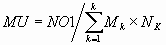
where, NO1- total number of ones in the kth group
Mk= number of machines in the kth subgroup
Nk=number of jobs in the kth subgroup.
Total Bond energy[ 7]
Measures of effectiveness (ME) is defined by

where m = number of rows in binary matrix
n= number of columns in binary matrix
Aij =1 if machine i is required by part j
0 otherwise
Global efficiency[23]
It is the ratio of the total number of operations that are performed within the suggested cells to total number of operations in the systems.
Group efficiency[24]
It is the ratio of difference between total number of maximum external cells that could be visited and total number of external cells actually visited by all parts to total number of maximum external cells that could be visited.
Group technology efficiency[23]
It is the ratio of difference between maximum number of intercell travels possible and number of intercell travels actually required by the system to the maximum number of intercell travels possible.
Grouping index
Nair and Narendran (1996) [6] incorporated, in addition to diagonal space and a weighing factor (A) and derived a new measure called Grouping index g

 where
where  and
and
e0= number of ones in the off-diagonal block
ev= number of voids in the diagonal block
q= weighing factor, 0£ q£ 1
B= block diagonal space (total number of elements in the diagonal block)
A=0 for e0 £ B
A=e0-B for eo>B
Weighted Grouping efficiency[4]
A weighting factor may be considered for each machine within the cell to get a better distribution of workload and by varying the weights on machines

where
e0= number of ones in the off-diagonal block
ev= number of voids in the diagonal block
d1=total number of elements in the diagonal block
q= weighing factor, 0£ q£ 1
Quality Index [25]
Quality Index (QI) is defined as the ratio of the intercellular workload (ICW) to the total Plant’s Workload. (PW)

Xil =1 if machine i is assigned to machine cell l
0 otherwise
Yjl =1 if part j is assigned to machine cell l
0 otherwise
Zij =1 if part j has operations on machine i
0 otherwise
Vj= production volume for part j
Tij= Processing time of part j on machine I
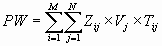
K, M, N = number of machine cells, machines and parts respectively
The Quality Index (QI) for a block diagonal machine component matrix is calculated as

3.4.1 COMPARISON OF DIFFERENT GROUPING MEASURE
Seifoddini and Djassemi (1996) [6] developed a simulated model for the performance evaluation of five different measures; bond energy measure, grouping efficiency, grouping efficacy, grouping capability measure and quality index. It is used to determine which measures predict more accurately the performance of the machine-part incidence matrix solution where the average flow time and in process inventories are used as variables to show the comparison of the measures graphically. They found that the efficiency of all these measures is 100% for a certain value of mean flow time and efficiency of all these measures begins to fall as the value of mean flow time increases, but the steepest fall occurs with QI measure. Grouping capability index and grouping efficiency measures give similar values of efficiency as grouping efficacy and bond-energy measures do give the similar results. Among these five measures, quality index gives the highest efficiency for a range of mean flow time. Seifoddini and Djassemi (1996) [6] claimed that QI is the measure of independence of machine-part groups, since independent machines are ideal for the formation of CMS, a high value of QI is expected to lead to a high performance level in the corresponding CMS
A distinct trend in the manufacturing research evident in the literature is the use of performance measures in developing models and optimizing various industrial operations. It has wide application in various types of manufacturing system, data collection and preparation. This approach has been adopted in capacity planning, facility planning and flexible manufacturing loading. It is clear in a CMS that the goodness of solution of a machine-part incidence matrix depends mostly on the perfection of forming a standard block diagonalized matrix. Many other factors like production volume, CPU time, machining requirements of parts, processing time may have influence on the goodness of a solution, but fortunately they are not taken into consideration in almost all the measures. Another important factor cost, is also not introduced effectively in any of the efficiency measures mentioned here.
3.4 CONCLUSION
In this chapter, we have had a glimpse of the various existent techniques of grouping the manufacturing facilities and product mix into production cells. We saw their basic methodology and identified their Pros and cons. It can be noticed that most methods are not restricted to a single type of basic clustering (either machine or component grouping), but they usually apply both groupings either concurrently or sequentially). Also, the methods often have a checking procedure which checks for irregularities and do some reassignments to give better cells. Moreover, It is clear in a CMS that the goodness of solution of a machine-part incidence matrix depends mostly on the perfection of forming a standard block diagonalized matrix. Many other factors like production volume, CPU time, machining requirements of parts, processing time may have influence on the goodness of a solution, but fortunately they are not taken into consideration in almost all the measures. Another important factor cost, is also not introduced effectively in any of the efficiency measures mentioned here.
CHAPTER 4
TRADITIONAL ALGORITHMS ON CELL FORMATION-
REVIEW AND COMMENTS
4.0 INTRODUCTION
Design of Cellular Manufacturing System has attracted several considerable attention of the researchers and also in industry in recent years. Many research papers have been published during these periods. This is because the main problem of introducing Group Technology lies in the identification from large varieties parts, those families which requires similar manufacturing operations. So various algorithms take care of these problems in different ways.
As mentioned earlier there are 3 basic things required for cell formation m/c grouping, part grouping and m/c part grouping. The main focus in this chapter is to throw some light on the existing algorithms. This includes;
Single linkage-clustering algorithm
Average linkage-clustering algorithm
Bond energy method
ROC, ROC 2 and MODROC, BETROC
Hierarchical Clustering- ZODAIC
Nonhierarchical clustering algorithm- GRAFICS
Apart from these, other approaches include mathematical programming model , like linear programming (LP) , Goal Programming (GP) and Integer Linear Programming(ILP) etc.
4.1 SINGLE LINKAGE CLUSTERING ALGORITHM (SLCA)
SLCA was put forward by McAuley [2] . Yhe method first clusters together those machines mutually related with the highest possible similarity coefficient, then it successively lowers the level of admission by steps of predetermined equal magnitudes,
The admission of a machine or a group of machines, into another group is by the criterion of single linkage. This means that if a specified similarity level would admit a machine into a cluster then a single linkage at that level with any member of that cluster would suffice to warrant condition. This method has a major disadvantage, while two clusters may be linked by this technique on the basis of a single bond, many of the members of the two clusters may be quite far removed from each other in terms of similarity.
4.2 AVERAGE LINKAGE CLUSTER ANALYSIS
This is the clustering technique, which base admission of a machine into a cluster on the average of the similarities of that machine with the machine already in the cluster. The weighted pair group method permits only one machine to join a cluster (or two clusters to come together), during one computational cycle. At the end of each cycle, a new similarity is then calculated. This method eliminates the possibility of machine joining a cluster simply because it has a high level of similarity with one of the machine already in the cluster. Difficulty with the method is that each time we have to recalculate the similarity matrix.
Seifoddini and Wolf [28] used average linkage clustering algorithm (ALCA) to overcome the chaining problem of SLCA. Their new model deals with the duplication of bottleneck machines, if inter cell moves are more than some threshold.
SLINK assigns the largest value of the similarity coefficient possessed by a pair of machines that consist of one machine each from two groups as the coefficient values for the two groups. CLINK (suggested by Seifoddini and Gupta, 1970 [28]) does the reverse. It assigns the smallest value of similarity coefficient possessed by a pair of machines from the two groups as the coefficient value for the two groups. CLINK is expected to result more closely bonded groups, due to the fact that each machine possesses similarity coefficient higher than the one for the two groups. Similarly there is another algorithm WLINK which takes the weighted average instead of simple average.
The weaknesses of this algorithm are;
While two clusters may linked by this technique on the basis of single bond many of the two clusters may be quite removed from each other in terms of similarity.
It aims at finding disjoint sets (unrealistic)
Method does not consider machine idle time.
4.3 BOND ENERGY ALGORITHM (BEA)
Mc Cormick et. al [7] developed this method in 1972. When all the rows and columns of the matrix are rearranged, then there are M! X N! total permutations possible. BEA systematically reduces number. Of permutations and selects the one with the maximum measure of effectiveness (ME), where
In BEA first row maximization is done.
i,e  and after that column maximization is done.
Algorithm:
Choose one row arbitrarily
Try placing individually the remaining N-1 rows in each of the I+1 possible locations (above and below the i columns already placed) and compare each row’s contribution to ME. Select the row with the largest incremental contribution and place it in its best location. Increase i by one and repeat this step till i=m
When all rows are placed, repeat the same procedure on columns
The weaknesses of BEA are;
(1) Tremendous amount of computational work. Therefore if matrix is large, calculation increases drastically.
(2) Clustering does not always result in a block diagonal form.
(3) Final solution depends on the initial choice of row column chosen.
4.4 ROC BASED ALGORITHMS
The ROC algorithm was put forward by King [2]. It aims at devising a generalized procedure that would convert, in a finite number of iterations, any original complex machine component matrix into a cluster diagonal form if one exists. When the algorithm terminates, one seeks a block diagonal structure in the sorted matrix.
The algorithmic details of ROC are as follows;
For each row of the machine-component matrix in turn, read the pattern of cell entries as a binary word. Rank the rows in order of decreasing value/ Rows with same values should arbitrarily be ranked in the same order in which they appear in their current matrix (reading from top to bottom).
Are current matrix row order (numbering from top to bottom) and the rank order just calculated the same? If yes, go to 4 or else go to 3.
Reform the machine –component matrix starting with the first row by rearranging the rows in decreasing rank order.
Rank the columns in order of decreasing binary value, columns in order of decreasing binary value, columns with the same value should arbitrarily ranked in the order in which they appear in this current matrix (reading from left to right)
Are the current matrix column order (numbering from top to bottom) and the rank order just calculated the same? If yes, go to 7 or else go to 6.
Reform the machine –component matrix starting with the first column by rearranging the column in decreasing rank order. Go to 1
Stop
The ROC algorithm is an iterative process that will in a finite number of steps, produce a matrix in which both columns and rows are arranged in order of decreasing binary value.
Bottleneck machines and the ROC
In practice a major restriction on the division of the machine component matrix into mutually exclusive groups, arises when a relatively large number of components require operations to be performed on certain readily identifiable machines. Such machines may be viewed as bottleneck machines to the extent that, if their number could be increased, then a mutually exclusive group solution could be found.
King proposed a relaxation procedure to solve this problem [2]. The bottleneck machines are decomposed such that every component requiring a bottleneck machine is allowed to have one to itself. The ROC algorithm is applied to this decomposed matrix and distinct groups achieved. Bottleneck machines within the same cell are now recomposed to give a maximum of one such cell. This gives the final cells with the required number of duplications of bottleneck machines.
Limitations of ROC;
Although ROC algorithm has been proved to be more efficient than the Bond Energy method, it has some serious drawbacks:
The final output, machine component matrix, is a function of the initial matrix. There is no set criterion of placing the columns (the process route of each component) or the rows (the various machines). This results in inconsistent outputs, quite often giving rise to large number of exceptional elements and/or fewer number of components.
The method does not involve the concept of similarity in the machine component matrix,
This method does not take into account the effect of number of components being produced, Also doesn’t incorporate any means for accommodating constraints on cell size.
Therefore to avoid limitation on matrix size and high order of complexity, King and Nakomchai [ ] came forward with a logical approach to modify the existing ROC algorithm (ROC-2) so that the result contains minimum number of exceptional elements.
In ROC-2, the whole procedure is reduced to that of shifting the order of rows and columns, The algorithm is as follows;
Repeat from the last columns to the first columns.
Do row reordering
Locate the rows (machines) with entries, move the rows with entries to the head of the row list, maintaining the previous order of the entries.
End Do row reordering
From the last row to the first rows
Do column reordering
Locate the columns (component) with entries, move the columns with entries to the head of the column list, maintaining the previous order of the entries.
End Do column reordering
Until no change or inspection method.
MODROC an algorithm using the ROC was put forward by Chandreshekaran and Rajagopalan [ 0]. They make the observation that the ROC algorithm results in a tendency to collect ones in the top left-hand corner. This leads to the formation of one component family and machine cell. The MODROC algorithm consists of 3 stages:
ROC algorithm is applied on the rows and columns of the initial data matrix repeatedly for two iterations. This results in an ordered matrix. This property of the ordered matrix is utilized in identifying a block (sub matrix that contains only one).
After identifying the block, the corresponding component family and machine cell are stored as partial output from stage 2. The cells are termed ‘Primary cells’, then the columns corresponding to the block are sliced off and removed from further consideration. The truncated matrix is then put through the ROC, algorithm followed by stage 2 (block and slice). This process is repeated until all component families are identified.
Hierarchical clustering of primary cells: A similarity coefficient is defined to give a measure between the primary machines cells to be clustered.
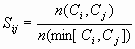
The similarity coefficient, called measure of association, is defined as the ratio of the number of common elements to the number of elements in the smaller cell. Using this measure of association a hierarchical clustering of primary cells is carried out. This process is carried out till either disjoint machine cells are obtained or a single cells is formed, In this latter case it is left to the designer to choose the level of hierarchy at which the grouping has to be implemented.
The advantage of MODROC is that the composition of primary cells remains more or less independent of the initial disposition of the matrix. The drawback of this method is that the algorithm does not consider the problem of exceptional elements and the final solution may have a large number of exceptional elements.
4.2.3 BETROC- A BETTER ALTERNATIVE TO ROC
BETROC by Subhas Babu, Nandurkar and Thomas [34] has been developed as a comprehensive improvement over ROC, ROC 2 , MODROC and ALTROC.. It was noticed that if a component is processed on a large number of machines. It is very likely that the cell in which it is included will not possess all the requisite machines to process it completely within the cell. There will be bound to be exceptions. In this case, it will be advantageous to process such components in another cell, which can be placed alongside of this cell so that different sets of operations are done in each cell. This will definitely be better than the assignment of the component to the remainder job cell. Hence a concept of duplicable components was addressed in BETROC.
Another unique consideration that was taken care in BETROC was a proper treatment of machine capacities and the component volumes and based on that, the duplication of machines/components were determined. The Steps involved in BETROC can be described in four stages[34].
Stage 1: Configuring the initial matrix.
ALCA is applied to initial 0-1 matrix and the groups are formed.
Stage 2: Application of ROC
(i) Applying ROC and identifying duplicable machines and components
(ii) Expanding the matrix by applying relaxation procedure for the duplicable rows as well as duplicable columns.
(iii) Applying ROC to expanded matrix to achieve distinct matrix.
(iv) Recomposition: The matrix is compressed back as much as possible.
Stage 3: Check and Reassignment: Each machine is now checked if there is any group in which if it is included, it will yield fewer exceptional components. If there is such a cell, the machine is reassigned to that cell. The same is done for components. Both checks are alternatively repeated till a stable solution is reached.
Stage 4: Clustering of cells. The smaller sized cells are clustered together based on criteria of two coefficients (reduction of duplicable machines and decrease in exceptional elements) to yield better solution
4.2.4 ZODIAC-IDEAL SEED NON HIERARCHICAL CLUSTERING ALGORITHM
This method was proposed by Chandrasekharan and Rajagopalan [11]. They argued that non hierarchical clustering method are preferred over hierarchical methods because they help natural clusters to emerge from the given data without permanently binding any unit by linking done in initial stages of execution. They suggested algorithm Zodiac (Zero one data ideal seed for clustering.) The formation of part family and machine cell has been treated as a problem of block diagonalization of the zero one matrix.
The existence of a solution depends upon whether the matrix can be rearranged in a block diagonal form in which all most all 1's occupy. The diagonal sub matrices and all most all zero's the off diagonal sub matrices. This is shown below. But such a solution may not always exists. The ZODIAC aims at getting the best diagonal form possible out of it and measures its efficiency.
Objective of the algorithm: Construct an algorithm to rearrange the rows and columns to the given zero-one matrix so as to get the efficiency close to 1.
Procedure: Stage I Non hierarchical clustering of columns and rows.
Compute limiting number k.
Choose K Seeds For Columns
Cluster Columns
Choose Representative Seeds
Cluster Columns
Find No Of Non Cell Cluster Kc
Modify Kc® K
Repeat Steps 2 To 5 For Rows
Find No Of Null Cell Cluster KR
10.) modify K® minimum(Kc ,KR)
11.) if (Kc¹ KR) go to step 2
12.) Reorder rows and columns in the order of cluster membership.
Stage II: Diagonalization
Stage I classifies the machines into cells and the components into families. The result is useful only if parts are assigned to their respective machines cells. This assignment should achieve twin objective of maximizing the inter cell movement.
Do for i=1,2,……….,k
a) Compute Fi for all columns cluster not already allotted.
b) Find Fr for the maximum value.
c) Allot cluster Cr to G
iReorder columns as per the new order of clusters
Compute h ,h R (set h ® h ' h R ® h '' )
If (h R» 1) stop.
Stage III; Clustering of ideal seeds.
Generate ideal seed for column clusters
Run steps 3 to 10 of 1 skipping step 4
Repeat 1 And 2 For Rows
Reorder Columns And Rows As Per The New Cluster
Compute h And h R.
If h ' ® h Revert To Earlier Grouping Else Go To 9
Go To 12
(Set h ® h ' )
Liquidate The Smallest Block (Optional)
go to 1
Stop
End.
Although Zodiac has a lot of good points compared to ROC and BEA, it is not without drawbacks, some of which are;
Improper choice of initial seeds cans leads to collapse of groups.
The clustering criterion based on minimum block distance is not justified
4.3 GRAFICS- NONHIERARCHICAL CLUSTERING ALGORITHM FOR GT
Most of the algorithms listed above were capable of solving well-structured matrices of GT. When applied to ill-structured matrices, they failed. Some of assume a fixed number of groups or an upper bound on the number of machines within a cell, which contradict the fundamental philosophy of GT that groups exist naturally.
Since, ZODIAC suffers the choice of the initial number of seeds, G. Srinivisan and Narendran T. T. [32] proposed a algorithm GRAFICS ( Grouping using assignment method for initial cluster).
Building on the premises of the choices of initial seeds based on the assignment method and the maximum density rule as the criterion, GRAFICS is used to block diagonalize a given machine-component incidence matrix.
The similarity between two machines i and j (Kusiak 1987)[12] is given by
Sij=S dk
Where dk= 1 if aik=ajk
=0 otherwise, and sjj=0 for all j
The similarity matrix for machines is computed and the matrix is used as the input to an assignment problem for machines with an objective of maximization. Subtours (Bellmore and Nemhauser 1968)[32] are identified from the assignments and are used to determine machine cells as well as seeds to cluster columns.
The seeds are used to cluster components and, in a manner, the component groups are used to generate seeds to cluster machines. Singleton clusters are eliminated by assigning them to seeds having at least one member clustered around them. This procedure of alternate seeding and clustering is continued until the numbers of row and column clusters are equal. Updating this solution as the latest feasible solution, the procedure is continued until either two feasible solutions are identical or the number of exceptions and blanks cease to decrease.
4.4 CONCLUSION:
Traditional cell formation problem did not cater the changes in demand for the product and in the product mix, resulting from unexpected product-order. However for successful cell implementation, flexibility is of considerable importance in order to cope with dynamic market conditions.
The traditional methods especially the ROC based algorithms do not address the sequence of operations, non consecutive operations on the same machines , volume of inter cell more as component quantity are generally processed in unequal volumes (Venugopal and Narendran (1992) and material having costs which depends upon the inter cell moves , component size and weight (Harhalakis et algorithm 1990). Hence the next chapter is introduced to overcome the shortcoming in traditional cell formation.
CHAPTER 5
NEW TRENDS IN GROUP TECHNOLOGY
5.0 INTRODUCTION
Since the advent of Group technology, a number of methods have been developed for grouping machines and parts, in order to exploit the benefits arising from cellular manufacturing, However, the part-machine grouping problem is yet to be solved satisfactorily, especially for large, industry size data sets involving thousand of parts and dozens of machine types.
Traditional cell formation problem models ignore many manufacturing factors and only consider machining operation of parts, so that a manufacturing system is presented by a binary machine-part incidence matrix. These methods however ignore major practical issues such as the sequence of machine operations for each part type and the size of cells. All these methods are not suitable because they cannot cater for practical problem, which have large number of parts to be classified into families, and require flexibility of specifying the number of cells and cell size limitation a priori. (Hindi and Hamam, 1994)[26].
The cell formation problem is a combinatorial optimization problem that is NP-hard. The optimization algorithms yield a globally optimal solution in a possibly prohibitive. Most of the approaches described in chapter 4 are tailored based algorithms for solving specific part family and machine group problems. None of these approaches guarantee near optimal solutions. Hence, metaheuristics have emerged to tackle the combinatorial optimization problems with global or near-global optimal solution in a reasonable computation time such as simulated annealing (Boctor 1991, Nagi and Proth 1990) , neural networks (Kaparthi and Suresh 1992)[13], Genetic algorithms, expert systems etc.
5.1 KNOWLEDGE-BASED SYSTEM
The general concept of knowledge-based system involves manipulating models and human experts to develop a system, which can be used by a wide range of users for solving a ill-structure type Cellular manufacturing problems. A particular application of KBS is in determining machine cells, part families and exceptional parts. Kusiak (1988)
[12] extended the cluster identification algorithm of Kusiak and Chow (1987) to develop a KBS which can be used to facilitate the formation of cells and families in a given set of resource constraints.
Some of the constraints that may be considered in a KBS system in cellular manufacturing are;
Maximum capacity of machine cells. Each machine cell contains not more than a specific number of machines.
Technological Constraints. A set of machines must/or must not be included in a single cell.
Total number of machine cells. The final solution of cellular manufacturing must have a specific number of machine cells.
The structure of KBS is shown in fig 5.1 and its components are as follows,
Users-Represents the end user of KBS
Interface- It is a device which communicate with the KBS
Model -The model to be adopted is the proposed algorithm, through which it would interact with the knowledge base to derive solutions to the specific problems.
Knowledge base- The knowledge base is also known as the production memory and consists of a set of pertinent rules, which will be used for solving the cellular manufacturing problems.
Chow and Hawaleshka in 1993 has identified 5 classes of rules; [ ]
Class 1 rules relate to CM problems whose solution has a specific number of machine cells.
Class 2 rules relate to CM problems where each cell holds not more than a specific number of machines.
Class 3 rules relate to CM problems that satisfy technical constraints such as a set of machines that must not be included in a single cell.
Class 4 rules read the above parameters and other related data sets.
Class 5 rules interact the above parameters with the model to come out with a optimum solution.
In short KBS increases the flexibility in solving the cellular manufacturing problems by considering the practical constraints such as maximum number of cells, size of machine cell etc.
5.2 FUZZY CLUSTERING APPROACH
The theory of fuzzy sets was proposed by Zadeh 1965 [16]. A great deal of research has been conducted in the areas of pattern recognization and expert systems with the applications in production/operations management. Fuzzy set methodologies have been applied in solving the problem of cellular manufacturing systems
The fuzzy clustering approach offers special advantages over conventional clustering. It not only reveals the specific part family or machine cell that a part or machine belongs to, but also provides the degree or grade of membership of a part or machine associated with each part family or machine cell. This information would give users more flexibility in determining in which part family a part should actually produced so that the workload among machines cells can be balanced.
Assuming that there are n parts and n machines to be grouped into c part families and corresponding machine cells. Conventional clustering methods implicitly assume that disjoint part families exist in the data set; therefore a part can only belong to one part family. The classification results, thus can be expressed as a binary matrix;
|
( i ) |
1 |
2 |
3 |
…… |
……… |
n |
|
1 |
1 |
0 |
0 |
…… |
……… |
0 |
|
2 |
0 |
1 |
1 |
…… |
……… |
0 |
|
3 |
. |
. |
. |
…… |
……… |
0 |
|
4 |
. |
. |
. |
…… |
……… |
. |
|
5 |
. |
. |
. |
…… |
……… |
. |
|
. |
. |
. |
. |
…… |
……… |
. |
|
. |
. |
. |
. |
…… |
……… |
. |
|
c |
0 |
0 |
0 |
……….. |
1 |
|
Fig 5.2 Conventional clustering taking binary values as input [16]
and that
uik=0 or 1,i = 1,2,……,c; k = 1,2,……n, ---------- (5.1)
 k = 1,2,…..,n, -----------(5.2)
0<  <= n, i = 1,2…c, #9; #9; -------------(5.3)
Constraint (5.1) ensures that uik = 1 if the kth part belongs to the ith part family. Constraint (5.2) ensures that each part exactly belongs to one part family. Constraint (5.3) ensures that each part family consists of at least one part.
But in many cases, part families are not completely disjoint, rather, the separation of part families is fuzzy. Consequently, the concept of fuzzy subsets could offer an advantage over conventional clustering and could allow a representation of the degree or grade of membership of a part associated with each part family. In fuzzy clustering, the classification results can be expressed as a matrix.
|
1 |
2 |
3 |
…… |
……… |
n |
|
|
1 |
u11 |
u12 |
u13 |
…… |
……… |
u1n |
|
2 |
u21 |
u22 |
u23 |
…… |
……… |
u3n |
|
3 |
u31 |
u32 |
u33 |
…… |
……… |
u3n |
|
. |
. |
. |
. |
. |
. |
. |
|
. |
. |
. |
. |
. |
. |
. |
|
. |
. |
. |
. |
. |
. |
. |
|
c |
uc1 |
uc2 |
uc3 |
. |
. |
ucn |
Fig 5.3 Clustering technique taking fuzzy values [16]
The uik values are not restricted to values 0 or 1, they can be fractional between 0 to 1. Therefore the part can belong to several part families with different degrees of membership.
The Problem of fuzzy clustering has received much attention, and several algorithms for solving cell formation problems have been proposed (Bezdek 1981).[ ] A generalized fuzzy algorithm is known to be addressed in most of the papers. Since the number of possible U matrices satisfies the above constraints, we need a objective criterion to optimize the solution. Though it can be in any inner product norm, the sum of square error functions
 is often used.
 is the desired membership function.
xkÎ X, where X= { x1, x2 ,…..,xn} is a data of n parts;
v =(v1, v2,………….. ,vn) is the center of cluster ui, i,e the mean vector of the parts in the ith part family.
U=[uik] is a matrix of fuzzy partition of X;
{uik}m = {ui(xk)}m
Bezdek (1981) proposed a iteration procedure to solve for the matrix U, which will result in a optimal solution of forming part families and machine cells. [16]
5.3 NEURAL NETWORK LEADER ALGORITHM FOR CELL FORMULATION
Pattern recognization approaches based on neural networks are beginning to be applied to group technology. The use of neural networks for classification and coding activity was discussed in Kaparthi and suresh (1991), [19] A carpenter-Grossberg neural network algorithm was introduced for the part-machine grouping problem. It was shown that as an adaptive leader algorithm, this approach not only can effectively handle large data sets and efficiently identify block-diagonal structures, but also test the robustness of the algorithm, i.e., the consistency of part-machine clusters, to the order of the presentation of input data.
5.3.1 CARPENTER-GROSSBERG NEURAL NETWORK
Artificial neural networks (ANN) are biological inspired; that is they are composed of processing elements that perform in a manner analogous to the elementary functions of the biological neurons (Wasserman, 1989)[20]. The neurons process may inputs and provides a single output. The architecture of a neural network is determined by the interconnection structure of neurons. The structure of the network gives it many unique capabilities similar to the processing capabilities of brain. For examples, it learns from experience, generalizes from the previous examples to new ones, and extracts the essential characteristics from the inputs that include irrelevant data.
The Carpenter-Grossberg neural network belongs to a class of networks that accepts binary-valued inputs. This network was developed by Carpenter and Grossberg (1986, 1988) [20] during the development of adaptive resonance theory (ART). The Carpenter-Grossberg neural network applied to group technology is based on unsupervised learning. The various classes are not known a priori, and the network is operated as a leader algorithm. As a series of input vectors (part-machine incidence matrix) are applied, the network clusters the input vectors into distinct classes depending on the similarities. A representative vector, known as exemplar (leader), is created and maintained for each class. If a new input is found to be similar to an existing exemplar, the input vector is classified under the class of that exemplar. The matching exemplar vector is also updated in the light of the new input. If a new input is not similar to any of the existing exemplars, it becomes new exemplars. Thus as all inputs are fed to the network, several exemplars are created, each one representing one cluster of vectors.
The main components of a Carpenter-Grossberg neural network are shown in fig[ ]. The network consists of two layers of neurons: the input (comparison) layer and the output (recognition) layer. The number of neurons in the input layer equals the number of elements in the input vector. For the given problem, if the input data is presented as rows of parts and columns of machines types, the number of elements in the input vector is the total number of machine types used. These neurons are numbered from 0 to N-1. Every neuron in this layer is totally connected (with top-down and bottom-up connections) to every neuron in the output layer. The output of the neurons required in the recognization layer corresponds to the maximum expected number of classes to which the input vectors may belong. These are numbered from 0 to M-1. The outputs of the output layer are also fed back to the input layer.
The steps involved in Carpenter-Grossberg algorithm given by Lippmann (1987), Pao (1989), and Kaparthi and Suresh (1992) [20] are as follows;
Intialize top-down and bottom-up connection weights and select r :
Top-down connection weights: tij(0)=1;
Bottom-up connection weights: bij(0)=1/(1+N);
For input nodes i=0 to N-1 and output nodes j=0 to M-1
Select a value for vigilance threshold between zero and one: 0£ r £ 1
Apply new input vector X, consisting of zero/one elements xi.
Compute matching scores:
The output, m j, of every output node j equals
m
j =  for j=0,…….M-1,
Select best matching exemplar, i, e node(q ) with maximum output:

The outputs of the other neurons are suppressed; in case of a tie choosing the neuron with lower j
Vigilance test (i, e, test of similarity with best matching exemplar):
Compute ê ê
X ê ê
=  i number of 1's in input vector.
Compute ê ê
T.X ê ê
=  iq
xi
number of perfectly matching 1's between input vector and the best matching exemplar.
iq
xi
number of perfectly matching 1's between input vector and the best matching exemplar.
If similarity
 r
Go to step 7; else go to step 6,
r
Go to step 7; else go to step 6,
Disable best matching exemplar temporarily.
The output of the best matching node selected in step 4 is temporarily set to zero; other outputs have been suppressed due to lateral inhibition; then go to step 3, In step 3, a new neuron in the output layer gets selected to represent the new class.
Update the best matching example

Repeat: Go to step 2, after enabling any nodes disabled in step 6.
The cell formation problem using the adaptive resonance theory approach was also explained by C.Dagli and R. Huggahalli [20], where they used ART1. A.Kusiak and H.Lee [] handled the problem of cell formation by proposing a 3 layer neural networks that integrate several manufacturing functions. Input provides a designer with the desired features that meet the current manufacturing constraints for design of a new component . Apart from that Suresh and Kaparthi also proposed a neural networks system for shape-based classification and coding of rotational parts .[20]
5.4 GENETIC ALGORITHM APPROACH
Venugopal and Narendran (1992) [26] modeled the cell formation problem based on minimization of total cell load variations using genetic algorithm. Cheng, Gupta, Lee and Wong (1998) formulated the cell formation problem as a traveling salesman problem (TSP) and a solution method based on the GA software, GENITOR developed by Whitley (1989) was proposed to solve the TSP-cell formation problem. MICEP Mishra (2001) developed a algorithm using GA whose main objective was to minimize intercellular movement of parts.
Hsu and Su (1998) [26] proposed a GA-based procedure to solve the machine-cell formation problem. More specifically, the study minimizes: (i) total cost, which includes intracell and intercell part transportation cost and machine investment costs; (ii) intracell machine loading imbalances; and (iii) intercell machine loading imbalance under many realistic considerations. Sarker and Xu (1998) reviewed the methods of cell formation problem to include multi-objectives cluster analysis.
For solving the cell formation problem by GA, different objectives functions are used depending on the requirement of the user. In GA implementation, three options are included: (i) minimization of the number of intercellular moves due to exceptional parts; (ii) minimizing intracell work load imbalances; and (iii) multi-objective function based on the (i) and (ii) options. The algorithm takes into account lower and upper bounds on the number of machines in a cell, and user-specified number of cells.
5.4.1 TERMINOLOGY AND CONCEPT
GA is a meta-heuristic for solving combinatorial optimization problem (Goldberg, 1989) [1]. In GA, a candidate solution is represented by a string of numbers, which denote the position of a machine in a sequence. A candidate solution is known as a string. A set of strings at time t is called a solution space S(t). The solution space at a given time is known as a state. The potential of an individual string is determined by a score function. The score function gives domain-specific information about the relative merit of each string. It maps strings into real numbers, which are used to determine the strings that will be used to produce intermediate state for the subsequent string. The GA procedure manipulates the solution space in such a way that better solutions are obtained in subsequent strings. Since a solution space is a set of possible solutions, GA applies the principle of parallelism to solve problems. For each solution space, the best solution is found, and by applying some GA operators, new solution spaces are explored, leading to better results. With the generation of each successive solution space, improvements in the quality of the individual solutions are gained. In this way a GA can move to a successful outcome without being confounded in local optima and without the need to examine every possible solution to the problem in a drastically small time. These characteristics make GA a novel metaheuristic for solving NP-hard problems
The GA procedure for a cellular manufacturing system problem is developed incorporating the design issues. The steps involved in solving the problem are;[38]
Step 1. Initialization. Select the initial input parameters and generate randomly an initial diversified population.
(i) Test for upper and lower bounds of machines ¯¯ test for constraints;
(ii) Set the values for population size, number of generations, probabilities of crossover and mutation, and number of cells;
(iii) Create randomly, an initial population,
Step 2. Selection and recombination. Select strings using stochastic sampling without replacement.
(i) Evaluate strings by objective function, fitness, and expected count calculation;
(ii) Create a temporary pool using the integer parts of expected count and use the fractional parts as success probabilities.
Step 3. Crossover/recombination. Apply the multi-crossover operator to tempop to create a selection pool of size,
(i) Candidates for crossover are selected randomly by remainder selection without replacement;
(ii) The multi-crossover operator is applied to two chosen strings, with a probability,
(iii) Apply mutation to subsequent strings ¯¯ normal mutation regardless of constraints;
(iv) Test for constraints; if violated, apply mutation until constraints are sufficed;
(v) Evaluate by calculating objective function values;
(vi) Sort out the selection pool in increasing order of objective function values.
Step 4. Replacement strategy. Compare each of the strings of sorted selection pool with corresponding old population strings.
(i) Compare corresponding strings in selection pool and old population, and take the best in turn;
(ii) Take the one that fares better than the other in each turn;
(iii) For other offspring, a random selection is made with a probability, 0.6491.
Step 5. Diversificating. Diversify the population if diversity falls below a predetermined minimum.
(i) Calculate the diversityof the population;
(ii) Compare with the given minimum, the acceptable diversity. If less, then apply mutation operator to the whole population, otherwise proceed. Repeat this process until diversity is satisfied.
(iii) Calculate the objective function values of the diversified population;
(iv) Sort out the new pool of strings in increasing order of objective function values.
Step 6. New Generation. The value of the current generation-number determines the next step.
(i) If generation is less than current population then current population becomes old population and the process is repeated;
(ii) Otherwise, stop. The solution is string with lowest objective function value in the current population. Print out the clustered solution
The "minimization of exceptional elements" model proves to be ideal for an optimization problem that is focused on minimization of intercell movement of parts during manufacture. Intercellular movements lead to transportation costs in a manufacturing firm, and should be reduced as much as possible. Therefore, minimizing exceptional elements leads to minimizing transportation cost between cell and consequently leads to reduced manufacturing cost. The "minimization of cell load variation" is ideal where balancing of workloads within cells is a design criteria or where there is a restriction on the available working time per period. Inclusion of several objective function options in the GA developed makes the approach flexible for designing cellular manufacturing systems. The GA method also allows the user to specify the number of cells. With such a facility the manufacturing systems design engineer is able to arrive at an optimum machine allocation to cells that respects the desired design criteria.
5.4.2 APPLICATION OF GA- MICEP
MICEP (Multistage Interactive Cell Evolution Process) has been developed by Mishra (2001) [43 ] in order to minimize intercellular movement of parts taking into account various parameters like parts visiting the machines, sequence of operations, batch size machine capacity and processing time of each parts on machines. He developed new similarity coefficient for both parts and machines by considering the above parameters. Having calculated the similarity coefficients for parts and machines, clusters are formed of those parts/machines, which have the highest similarity coefficient.Then assignment algorithm is applied to assign machine groups to part families [ ] Thus, the solution obtained from assignment algorithm is taken as initial starting point for cell formation by GA. This initial solution serves as the initial population and basic operations of GA like reproduction, cross over and mutation (described earlier) are carried out to improve the solution. The synaptic view of MICEP is shown in fig ()
The basic concept of genetic algorithm is based on the evolution process that occurs in natural biology. An initial population of possible solutions is generated. Some individuals are selected to be parents to produce offspring via crossover operations. All the individuals are then evaluated and selected based on the concepts of survival of the fittest. The process of reproduction, evaluation and selection is repeated until a termination criterion is reached.
There are 3 basic operations performed in genetic algorithm as reproduction, crossover and mutation. Reproduction is based on the value of the objective function defined. Crossover is the interchanging of genes between two chromosomes.
The objective is to assign the machine groups to the part families so as to maximize the total number of operations in a particular cell. To achieve this objective, machine groups are assigned to each part family by assignment method. For example the notation 3-2-1 signifies that the 3rd machine group goes to part family 1 which is in cell 1 the 2nd machine group goes to part family 2 which is in cell 2 and the 1st machine group is with part family 3 which is in cell 3.Here it is assumed that the 1st part family is in cell1 , 2nd part family is in cell 2 and the 3rd part family is in cell 3.This is done without any loss of generosity because the machine groups are to be assigned to them which really matters.
The idea behind the application of genetic algorithm is to optimize certain problem for a given cost function. To use the concept of genetic algorithm in CMS, the most important problem is to identify the cost function. There may be so many cost functions that can be used for designing a cell. The one considered here is the number of machining operations of a particular part performed in that cell .A particular cell can have a limited number of machines . If a part of the part family assigned to that machine group has to be performed an operation in a machine that is not in the machine groups assigned to it, then it has to move to some other cell which contains that machine. If this is the case, then the benefit of cellular manufacturing systems is lost, because in the idle case all the cells should be independent and there should be no intercellular movement between the cells. So the cost function considered here takes care of this aspect of cell formation. The cost function is the total number of operations performed in a particular cell and the objective is to maximize this function. This way number of inter cellular movement is minimized.
The steps in MICEP for cell formation by GA are
Define initial population size and number of generation after which the solution is required.
Apply GA principles for formation of cells in several generations.
On doing so, the winner chromosome emerges out and the cell is formed accordingly.
The proposed algorithm used the principle of optimization through the use of genetic algorithm and assignment model. The advantage is to get the cells formed with higher maximum number of operations within the cells.
The complete algorithm used for the cell formation using the genetic algorithm technique is as follows.
Step 1
The search space of all possible solutions is mapped onto a set of finite string ; the alphabet of symbols is of finite dimension. Here it is as per the assignment of machine groups to the part family and therefore to the cells.
Step 2
A set of solutions is selected at random and this constitutes the initial population i.e. the 1st generation.
Step 3
A fitness is computed for each of the individuals. The fitness function considered here is the total number of visits that each part in each cell make to each machines in the machine group assigned to that part family . Fitness is a parameter which reflects the quality of the solution represented by the individual. The objective therefore is to maximize the total no of visits within a cell.
Step 4
A set of individual are selected to reproduce itself. The selection takes place in a random way but with a probability proportional to fitness.
Step 5
From the selected set some progeny is generated by applying different genetic operators. Some of the old individuals are eliminated from the population to allow the entrance of the new ones.
Step 6
The new individuals fitness is computed and they are included in the population . This step marks the end of the generation.
Step 7
IF the iteration threshold is reached , THEN the process is finished and the best chromosome is returned , ELSE GOTO step 4
&#The cost function which is the total number of visits of anypart in a partfamily to the machines in the assigned machine group can be defined as:
Maximize : Total visits =
Where i=1,2,……….N No of part families
j=1,2,……….N No of machine groups
Xij =1 if a member of a part family i visits member of the machine groups
j assigned to it
= 0 otherwise
The flow chart for the application of genetic algorithm is shown in Figure
The application of MICEP is very useful and handy for any size of data. The results were compared with existing algorithms and found to be more efficient in solving the cell formation problem by minimizing intercellular movement of parts.
5.5 MATHEMATICAL PROGRAMMING MODEL
The mathematical programming model for comprehensively dealing with exceptional elements in cellular manufacturing systems, first introduced by Shafer et al. [31], explicitly considers three cost categories: (1) subcontracting costs; (2) machine duplication costs; and (3) intercellular transfer costs. Under the assumption that an initial cell formation solution, and hence the EEs, have been found, the basic model is given as follows:
where the decision variables are
Xi = units of part i to be subcontracted,
Ykf = number of machines of type k to be purchased for cell f,
Zik = number of intercellular transfer required by part i because of no of machine type k available within the part’s cell,
Mik= number of machines of type k dedicated to production of part i (utilization of
machine type k to produce part I)
and the major parameters are
Ak = annual total cost of a mchine of type k,
Si= incremental cost of subcontracting a unit of part i,
Ii= incremental cost for moving part i outside of a cell,
Ck = annual capacity of machine type k,
Di = annual demand for part i,
Pik= processing time of part i on a machine of type k,
Gf =set of exceptional parts in cell f,
Hf = set of bottleneck machines required by parts in cell f.
The above model is a mixed integer program (MIP). In the objective function (1), the first component represents the subcontracting cost, the second represents the machine duplication cost, and the third represents the intercellular transfer costs associated with remaining EEs. Constraint (2) is a logical balance on the number of intercellular transfers for exceptional elements. Constraint (3) ensures that the total number of machines of type k, used for production of exceptional parts in a cell, does not exceed the number of type k machines to be purchased for that cell. Constraint (4) represents the necessary integer restrictions for variables Xi, Ykf, Zik.
This model explicitly considers total cost as the basis in choosing the best combination of the strategies for designing a CM system. It has practical value and is very flexible in real-world situations for dealing with EEs. The parameters employed in the model are generally available for practical situations. The cost function and the constraints can be expanded to meet the varied, individualized requirements of different CM environments. It also provides a systematic approach for management to evaluate the economic consequence of EEs from both operational and strategic perspectives.
In their original formulation and solution, Shafer et al. [3 ] relax the integer restriction on the variables Xi and Zik for simplicity and solve it using LINDO [3]
5.5 SIMULATED ANNEALING APPROACH TO CMS
Venugopal and Narendran 1990 [39]has proposed an algorithm based on simulated annealing to solve the machine-component grouping problem for design of cells in manufacturing systems.
SA is a powerful and general random search method by Kirkpatrick et al to solve combinatorial optimization problems. It was inspired by the analogy to the process of cooling a physical system slowly in order to reach a state with globally minimum potential energy, simulated annealing algorithm generally accepts all solutions that improve the objective function, while those which do not result in improvements may be accepted with non-zero probability.
The steps involved in SA algorithm for the cell formation problem is as follows.[39]
Step 1: Initialization step
Set r= 0; n=0,
Step 2: (Temperature initialization)
Choose the initial temperature Tr,
Step 3: Configuration initialization
Determine an initial assignment (configuration) of machines to cells, perhaps randomly, i.e, choose the initial matrix as a random configuration of cells.
Step 4: (Computation Of energy)
Compute the total cell load variation (energy) of the current assignment of machines to cells.
Step 5: (Perturbation Scheme)
Randomly select two machines, u and v, either change their cell membership or mutually exchange their cell memberships, with equal probability so that a new assignment, say, j, results. Evaluate the consequent change in cell load variation.
If the difference in change (d ) is less than 0
Select a random variable y (0,1)
If y>P (d )=exp (-d /Tr), go to step 5a
Then accept the new configuration i,e new cell membership, and set n=n+1; if N<e(epoch), go to step 5a
Step 6: (Testing for equilibrium state).
Set n=0 and if the system has not dwelt at the current temperature for a specified markov chain length then the system is assumed to be in equilibrium at temperature Tr, select the next annealing temperature and go to step 5a.
The use of simulated annealing to solve the machine-grouping problem is an important aspect of Cellular manufacturing systems. The main advantage of the SA algorithm is that it is easy to implement, and this is found to yield better results for the best parameter setting. Hence this method is recommended for large problems with interval level data where workload balance among machines is desired.
5.6 CONCLUSION:
All these non-conventional methods aim at providing a new dimension to the cell formation problem and to enhance its operational efficiency. As the customer demands goes on increasing, there is enough pressure on the manufacturing industries to meet their expectations. This flexibility can be provided in a better way in the Cellular Manufacturing Systems by following this modern technique. Also as no of products goes on increasing input is very difficult to compute the no of cells etc by conventional methods. So these approaches also provide computational efficiency. They can take care of all the functions issues that have so far been ignored by the traditional methods. On the whole these methods are more realistic and efficient and provides a better solution than the traditional methods.
CHAPTER 7
CONCLUSION
6.0 SUMMARY
Due to the number and diversity of factors that have to be considered, cell design in a specific manufacturing site is a complex and daunting task. A brief review on this topic concludes that cellular manufacturing systems are gaining increasing popularity as a way to quickly improve productivity and competitiveness and hence there is much research devoted in development of various algorithms. As the traditional algorithms developed have many cons in terms of flexibility, many new techniques of cell formation have emerged out to cope with the fluctuating market demand.
In this report, a brief review of issues related CMS, cell formation techniques and a few traditional algorithms are discussed. Some modern techniques like knowledge based systems, fuzzy clustering, neural networks, simulated annealing, genetic algorithm applied to CMS are explained, which is the stepping stone for further development in area of CMS.
An attempt has been made to identify a problem of cell formation and apply modern techniques (GA) to it.
6.1 PROBLEM ON HAND
The primary aim of cell formation problem is to make the cells flexible to suit with real time manufacturing systems. Keeping this in mind, the following tasks are intend to be done in future
Develop algorithms taking into account the constraints like sequence, batch size, operation time, machine capacity etc (MICEP) by using Genetic algorithm technique due to its effectiveness in handling similarity coefficients of parts/machines.
Develop a new similarity coefficient, which considers alternative routes during machine failures (machine reliability).
Develop new group efficiency measures.
Thus the solution obtained will be tested for different data and will be compared with different existing algorithms.
Also analyze the solution using simulation (promodel)
REFERENCES
Aktur M.Selim and Wilson George R. (1998) , ' A hierarchical model for the cell loading problem of cellular manufacturing systems' , International Journal of Production Research , 36 , 2005-2023.
Arvindh B. and S. A. Irani (1994),’ Principal component analysis for evaluating the feasibility of cellular manufacturing without initial machine-part matrix clustering’, International Journal of Production Research , 32 , 1909-1938.
Arn E.A.(1975),’Group technology : an integrated planning and implementation concept for small and medium batch producer,Springer-verlog,Newyork.
Askin Ronald G., Selim Hassan M.and Vakharia Asoo J. (1997) , ' A methodology for designing flexible cellular manufacturing systems ' , IIE transactions , 29 , 599-610.
Basu A., Hyer N. and Shtub A(1995),’An Expert System based approach to manufacturing cell design’,International Journal Of Production Research ,10,2739-2755.
Bhaba R. Sarker (2001), ‘ Theory and Methodology: Measures of grouping efficiency in Cellular manufacturing Systems’, European Journal of Operational Research,130,588-611
Boe J. Warren and Cheng Chun Hung(1991),'A close neighbour algorithm for designing CMS', International Journal of Production Research, 29,2097-2116.
Burbidge John L(1992),’Change to GT: Process organization is obsolete’,International Journal Of Production Research,30,1209-1219.
Burbidge J. (1975) , ' The Introduction to Group Technology' , (London: Heinemann )
Chandrasekharan M.P. and Rajgopalan R. (1986 a),'MODROC' : An extension of rank order clustering for Group Technology ' , International Journal of Production Research , 24 ,451-464.
Chandrasekharan M.P. and Rajgopalan R. (1987) , 'ZODIAC : an algorithm for concurrent formation of part families and machine cells ' , International Journal of Production Research , 25,835-850.
Chandrasekharan M.P. and Rajgopalan R. (1986 ), ‘Clustering algorithm for cellular manufacturing’, International Journal of Production Research , 24, 451-464.
Chen S.J. and Cheng C.S.(1998),'A NN based approach for cell formation ', International Journal Of Production Research',33,293-318.
Choobineh F. (1988), ‘ A framework for the design of cellular manufacturing systems’, International Journal of Production Research, 26, 1161-1172
Chow S. Wing and Ostap Hawaleshka (1993), ’A novel machine grouping and knowledge-based approach for cellular manufacturing,’ European Journal of Operational Research, 69,357-372.
Chu Chao- Hsien and Jack C. Hayya (1991), ' A fuzzy clustering approach to manufacturing cell formation , International Journal of Production Research ,29,1475 -1487.
Gallagher-----book
Kalpak Jian Seropac (1989),’ Manufacturing Engineering and technology’,
Addiso-Wesley publishing company.
Kaparthi S and Suresh Nallan C.(1992),’Machine Component cell formation in GT:A NN approach’,International Journal Of Production Research, 30, 1353-1367.
Kaparthi S, Suresh Nallan C. and Cerveny Robert P. (1993), ‘ An improved neural network leader algorithm for part machine grouping in GT’, European Journal of Operational Research, 69,342-356.
King J. R and Nakornchai V. (1982),’Machine component group formation in GT: Review and extension’, International Journal Of Production Research, 30, 1353-1367.
Luong L. H. S. (1993), ‘A cellular similarity coefficient algorithm for the design of manufacturing cells’, International Journal Of Production Research',31,1757-1766.
Nair Jayakrishnan G. and Narendran T.T.(1998),'CASE: A clustering algorithm for cell formation with sequence data', International Journal Of Production Research',36,157-179.
Nandurkar K N and Subash Babu A. (1998), ' Development of virtual cellular manufacturing system for SME's',Proceedings of the 18th all India Manufacturing Technology design and Research.
Nandurkar K.N., Thomas Austin and Babu A.Subash ,'Bipronged approach for cluster analysis(BIACA):A Cell Formation Algorithm',
Onwubolu G. C. and Mutingi M.(2001),’A genetic algorithm to cellular manufacturing systems’, Computers and Industrial Engineering, 39, 125-144
Palmer Chareles C. and Kershenbaum Aaron , ' An approach to a problem in network design using genetic algorithms' , Networks,26,51-163.
Rajagopal S. (1987), ‘
Sankaran S. and Kasilingam R.G. (1993), ‘On cell size and machine requirements planning in group technology systems’, European Journal of Operational Research, 69,373-383
Seifoddini H. and Wolf D. M(1986),’ Application of similarity coefficient method in GT’, IIE, 271-277
Singh N, (1993) ‘Design of cellular manufacturing system- An invited review’, European Journal of Production Research , 200-210, 69, 284-291
Srinivasan G. and Narendran T. T.,’ GRAFICS- a nonhierarchical clustering algorithm for group technology’, International Journal of Production Research, 3 , 463-478.
Song S. and Choi J.(1993),’Optimization analysis of flexible manufacturing system’, European Journal of Operational Research, 69,399-412
Thomas A. J(1989), ‘Cell formation in GT systems’, BTP report
Vakharia Asoo J.Wemmwerlov Urban(1990),'Designing a CMS: A material flow approach based on operation sequence', IIE transaction ,22,84-97.
European Journal of Operational Research, 69,373-383
Vakharia A. J. and Chang Y. L. (1997),’ Cell formation in group technology: a combinatorial search approach’, International Journal Of Production Research, 35,2025-2043.
Venugopal V. and Narendran T. T. ( 1992), ‘ A genetic algorithm approach to the machine component grouping problem with multiple objectives’, Computers and Industrial Engineering, 22, 469-480.
Wang T, Chang H. L. and Wu K. B. (1998),’An improved simulated annealing for facility layout problems in cellular manufacturing systems, Computers and Industrial Engineering, 34, 309-319
Welch arthor, Emang John T.(1982),'Group Technology: Heart of flexible manufacturing systems', proceedings of the 1st International Conference on Flexible Manufacturing Systems',IFS publication ltd. Bedford, England.
Wemmerlov and D. J. Johnson (1997), ' Cellular manufacturing at 46 user plant implementation experiences and performance improvements’, International Journal of Production Research, 35, 29-49.
Wemmerlov Urban and Nancy L. Hyer.(1987),'Research issues in CMS', International Journal of Production Research ,25,413-431.
Mishra D. (2001) MTP thesis